Navigating The Winter Blues With Marriage Counseling: Tips For Couples
Winter has a quiet way of changing the atmosphere inside your home.
The days grow shorter. Evenings stretch longer. Plans slow down. You spend more time indoors, physically closer, yet sometimes emotionally farther apart. What once felt easy now requires effort. Conversations feel heavier. Small disagreements linger. Patience runs thinner than usual.
And it can be confusing.
You might think, Why are we struggling? Nothing dramatic has happened.
In our work at Courtenay Monfore, PLLC, providing couples counseling in Charlotte, NC, we often see that winter doesn’t create relationship problems. It amplifies the ones that were already there. When emotional bandwidth decreases, communication requires more intention. Repair requires more effort. Connection becomes something you must actively protect.
Winter can also be a season of strengthening. With awareness and a few intentional shifts, couples can move through this time feeling steadier rather than more distant.
Key Takeaways
Winter often magnifies existing relationship patterns rather than creating new ones.
Reduced daylight and stress can impact mood, patience, and emotional regulation.
Small, consistent connection habits matter more than dramatic gestures.
Differences in stress responses are often attachment-based, not personal.
Working with a marriage therapist in Charlotte, NC, can help interrupt recurring cycles before they deepen.
Why Winter Feels Heavier In Relationships
Winter affects more than your calendar. It affects your nervous system. Lower light exposure, disrupted routines, and increased time indoors influence energy and mood. Even subtle shifts can affect how you show up in your relationship.
You may feel:
More easily irritated
Slower to recover after conflict.
Less motivated to initiatea connection
More inclined to withdraw
When both partners are navigating these shifts at once, misunderstandings increase naturally.
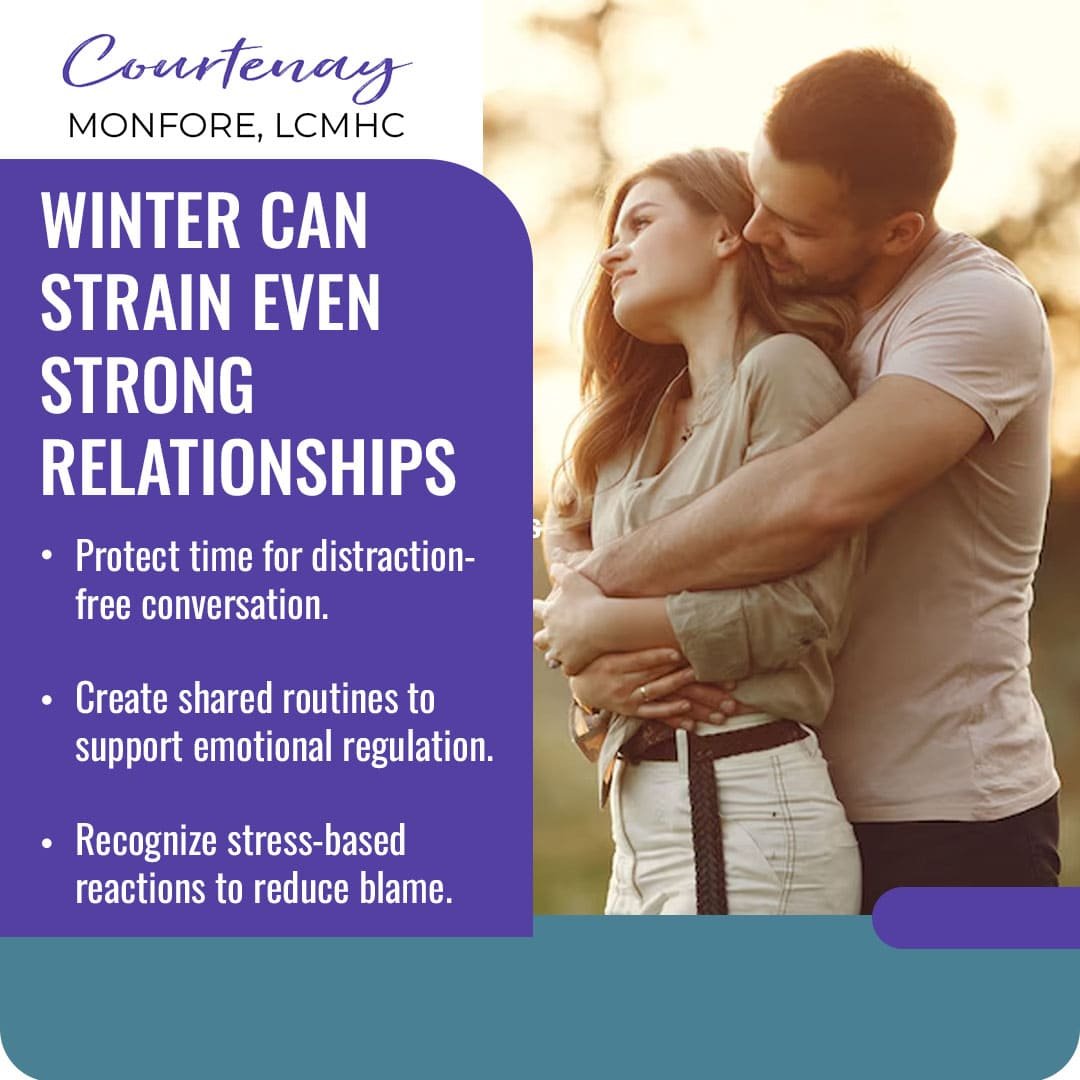
Seasonal Stress And Emotional Regulation
For some people, seasonal depression is significant. For others, it’s a quieter dip in energy and optimism. Either way, reduced emotional regulation makes it harder to pause before reacting.
In sessions with marriage counselors in NC, couples often realize they have been interpreting stress reactions as personal rejection. Once seasonal strain is acknowledged, the dynamic begins to soften.
Instead of:
“You’re being distant.”
It becomes:
“We’re both running low right now.”
That reframing alone can change the tone of an entire season.
Winter Shrinks Your Margin For Error
Think of emotional capacity as a cushion.
When you’re rested and grounded, there’s room to absorb stress. You can pause. You can listen. You can repair.
In winter, that cushion thins.
You may snap faster. Apologize slower. Replay conversations longer. Small issues, tone, timing, and chores feel disproportionately heavy.
The problem hasn’t grown. Your reserve has decreased. In relationship counseling in Charlotte, we often help couples recognize that reactivity isn’t proof of incompatibility. It’s often exhaustion.
When you protect your margin by taking breaks early, speaking more clearly, and offering reassurance, you reduce escalation before it starts.
Communication Quietly Changes During Winter
As the season contracts, communication often does too.
You may still talk, but mostly about logistics. Work schedules. Responsibilities. Planning. The emotional layer fades into the background.
The Loss Of Everyday Connection
In warmer months, shared experiences create natural opportunities for closeness. Winter reduces spontaneity.
You might find yourselves:
Sitting side by side but emotionally separate
Scrolling instead of conversing
Ending the day without meaningful check-ins
Research from the Gottman Institute describes “bids” for connection, small moments where one partner reaches out. Turning toward those bids builds stability over time.
Winter fatigue makes bids easier to miss.
Local marriage counselors often help couples rebuild awareness around these small exchanges. Often, connection returns not through dramatic conversations but through consistent responsiveness.
Repair Is More Important Than Perfection
Conflict is not the enemy. Unrepaired conflict is.
Winter strain makes repair slower unless it becomes intentional.
A simple shift can help: “I’m feeling overwhelmed. I don’t want this to turn into something bigger. Can we pause and come back to it?”
Couples working with best couples counselors frequently discover that imperfect but timely repair builds more safety than trying to avoid disagreement altogether.
Attachment Patterns Intensify Under Stress
Stress amplifies attachment tendencies.
If you seek reassurance when overwhelmed, winter may increase that need. If you withdraw when overstimulated, winter may deepen that instinct.
Neither response is wrong. Both are protective.
When Closeness And Space Collide
One partner may feel anxious when distance appears. The other may feel pressured when emotions rise.
One leans in. The other pulls back.
Among Charlotte marriage therapists, there is broad agreement that naming this pursue-withdraw cycle reduces shame. When partners see behavior as protection rather than rejection, defensiveness decreases.
Instead of: “Why are you shutting me out?”
Try: “When you get quiet, I feel unsure. Can you tell me what’s happening for you?”
Curiosity invites connection. The accusation closes it.
Clear Requests Prevent Assumptions
Indirect communication often backfires during low-energy seasons.
Instead of: “You never talk anymore.” Try: “I miss feeling connected. Can we sit together for ten minutes tonight?”
Many couples searching for the best marriage counselors in Charlotte, NC, are looking for this skill, directness without blame.
Clarity lowers anxiety. Lower anxiety reduces conflict.
Small Habits That Strengthen Connection
Winter connection rarely comes from one big gesture. It grows from repeatable habits.
Protect Daily Check-Ins
Even ten minutes of distraction-free conversation each day can stabilize closeness. Not problem-solving, just checking in.
Questions like:
“What felt heavy today?”
“What felt encouraging?”
Couples engaged in relationship counseling in Charlotte often realize that structured check-ins rebuild safety over time.
Regulate Together
Shared movement and shared quiet regulate the nervous system.
A short walk before dinner. Sitting in natural light. A calm evening ritual.
In our work at Courtenay Monfore, PLLC, we frequently see that couples who regulate together manage conflict more effectively.
You don’t need a dramatic change. You need shared rhythm.
Isolation Increases Pressure
Winter reduces social contact. Fewer gatherings. Less outdoor time. Smaller circles.
When outside connection shrinks, couples lean more heavily on each other.
That can feel intimate or overwhelming.
If your partner becomes your only emotional outlet, pressure increases. Maintaining friendships and individual routines supports the relationship.
Balanced support systems create stability.
When Winter Exposes A Deeper Pattern
Sometimes winter doesn’t just amplify stress; it reveals cycles that have been present for years.
You may notice:
Arguments repeating without resolution
Emotional withdrawal increasing
Apologies that feel surface-level
One partner feels chronically unheard.
When self-guided conversations stop working, structured support can help.
Many couples begin searching for a professional marriage therapist in Charlotte, NC, when they realize they are stuck in a recurring cycle.
Seeking help is preventative. It means you care about protecting the relationship before damage deepens.

What Therapy For Couples Actually Looks Like
Some couples hesitate because they imagine therapy as an endless discussion of past problems.
Effective therapy balances understanding with skill-building.
You identify the conflict cycle. You learn what each partner is protecting. You practice new responses in session. You leave with tools.
Couples comparing marriage counselors in NC often want both warmth and structure. The best marriage counselors provide emotional safety while also guiding change.
At Courtenay Monfore, PLLC, we integrate Emotionally Focused Therapy, the Gottman Method, trauma-informed care, and Brainspotting when appropriate. That structure allows us to tailor sessions while maintaining clarity and direction.
Therapy should feel collaborative, not like taking sides, but like learning how to stand on the same side again.
Moving Through Winter With Intention
Winter can expose strain, but it can also strengthen resilience.
When you:
Recognize seasonal stress
Protect your emotional margin.
Repair quickly
Ask clearly for what you need.
Maintain small connection rituals.
You build stability that lasts beyond the season.
If winter has highlighted patterns that feel difficult to shift alone, couples counseling services in Charlotte, NC, can provide structure and support.
To learn more about working with Courtenay Monfore, PLLC, call (704) 741-2082 or email hello@courtenaymonfore.com. You do not have to navigate this season alone.
About Me
I’m Courtenay Monfore, a trauma-focused therapist based in Charlotte, NC. I offer in-person therapy at my Fairview Road office as well as virtual sessions throughout North Carolina and South Carolina. My work is centered on helping you create a thriving relationship with yourself and the people who matter most to you.
I understand how exhausting it can feel when stress becomes constant, when your mind won’t slow down, conflict keeps repeating, or you feel stuck in patterns you can’t quite explain. You may look like you’re holding everything together on the outside, but internally, it feels overwhelming. I believe many of the troubling thoughts, emotions, and behaviors we experience are rooted in unresolved experiences. When we gently uncover and process those roots, meaningful and lasting change becomes possible.
I work with individuals, couples, teens, and young adults who feel disconnected, anxious, or unsure how to move forward. My approach is collaborative and goal-oriented. Together, we identify the patterns keeping you stuck and begin building new ways of responding that feel more grounded and empowering. I integrate evidence-based methods, including Emotionally Focused Therapy, the Gottman Method, Brainspotting, and trauma-informed care, to support deep and sustainable healing.
My goal is for you to feel understood, supported, and equipped with tools that help you experience life differently, more connected, more confident, and more at peace.
