Teenage Angst or Something More? A Guide By Courtenay Monfore PLLC
Adolescence has always been emotionally demanding, but today’s teens are navigating a world that feels faster, louder, and more pressured than ever before. Many teens feel lost, overwhelmed, worried, or frustrated without fully understanding why. If you are a parent reading this, you may recognize these shifts and wonder whether this is simply part of growing up or something more. As a teen therapist in Charlotte, NC, I hear this question often. Families want to help. They just don’t want to say the wrong thing or push their teen further away.
Teenage emotions can be intense, but when distress becomes constant, it begins to take a toll on relationships, energy, motivation, and self-care. This article explores how to recognize when typical stress shifts into teenage depression, why today’s teens are particularly vulnerable, and how gentle, supportive intervention can help your teen feel calmer, more understood, and more in control of their lives.
Key Takeaways
Teen depression often develops quietly and is frequently mistaken for typical adolescent behavior, which can delay meaningful support.
Sustained pressure without relief can leave teens feeling emotionally stuck, withdrawn, and less likely to ask for help.
Gentle, attachment-informed parenting that prioritizes connection and emotional safety is more effective than control-based approaches during adolescence.
Authoritative parenting, combining warmth, responsiveness, and clear boundaries, supports healthier emotional regulation and communication in teens.
Therapy helps teens build the internal skills needed to manage stress, strengthen resilience, and carry these capacities into adulthood.
Growing Up Today Comes With Constant Pressure
Being a teenager means dealing with physical, emotional, hormonal, intellectual, and social changes all at once. Teens are expected to perform well academically, manage extracurricular commitments, maintain friendships, and plan for the future, often without having the emotional tools to do so confidently.
Many teens quietly carry fears such as “What if I let myself or others down?” or “Is this pressure ever going to leave me alone?” These thoughts may not always be voiced, but they shape how your teen experiences themselves and the world around them.
What the Data Tells Us About Teen Distress
According to the Centers for Disease Control and Prevention’s 2023 Youth Risk Behavior Survey, approximately 40% of U.S. high school students reported persistent feelings of sadness or hopelessness over the past year, down slightly from about 42% in 2021 but still significantly higher than a decade ago.
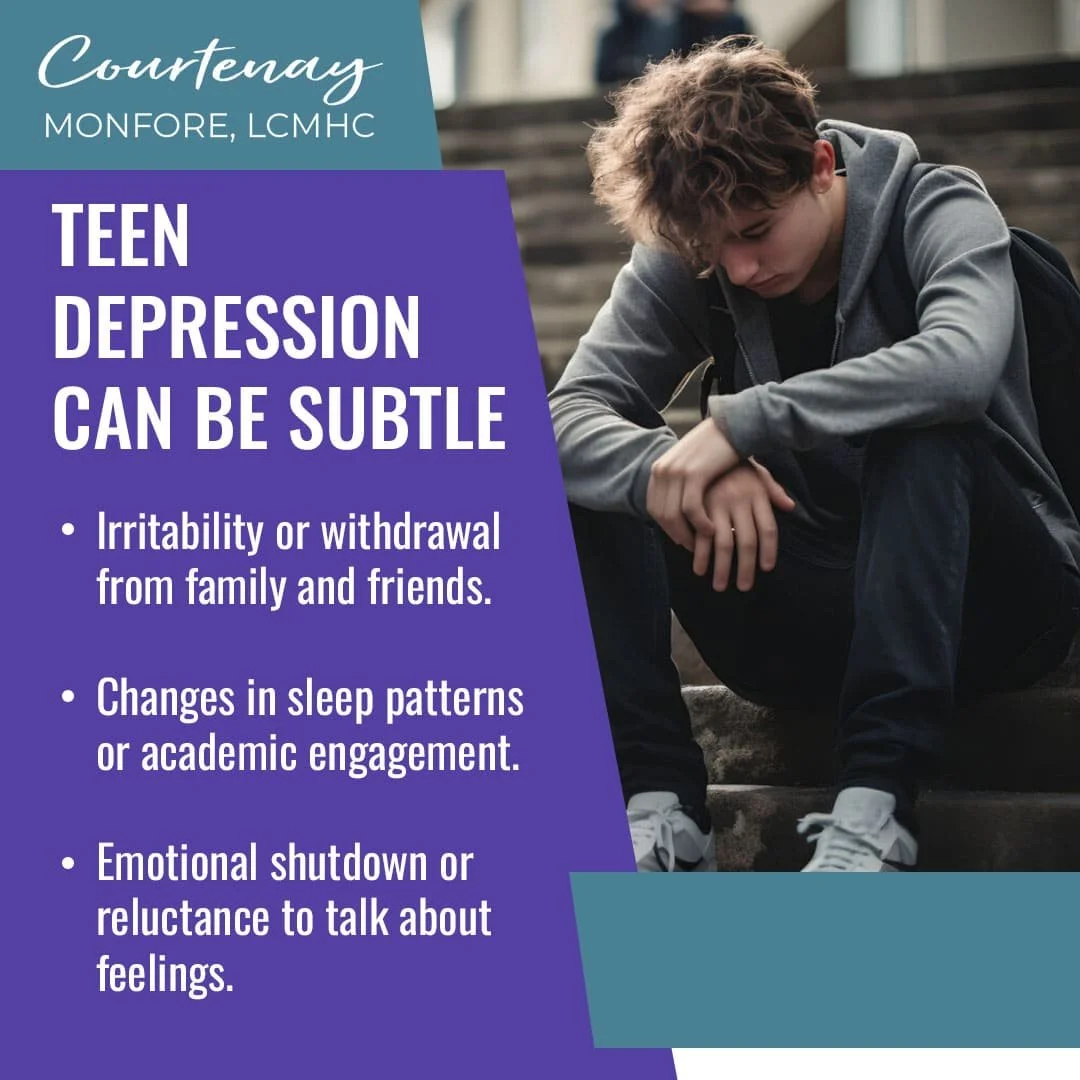
From our perspective as therapists for teenage depression, prolonged pressure without relief often leaves teens feeling trapped instead of motivated. Over time, this sense of being stuck can begin to weigh heavily on a teen’s sense of self. They may shut down emotionally, grow more irritable, pull away from friends, or struggle to sleep. Slowly, they may start believing that nothing they do will make a difference. When these patterns persist, your teen may stop reaching out for support altogether, not because they do not want help, but because they feel overwhelmed and unsure where to turn.
When Emotional Strain Turns Into Teenage Depression
Not every difficult week signals a mental health concern. However, teenage depression tends to show up through persistence rather than intensity alone. When sadness, irritability, or numbness lasts for weeks, it can interfere with sleep, school, relationships, and daily functioning.
Many teens experiencing depression do not appear overtly sad. Instead, they may seem distant, quick to anger, or unusually quiet. For parents, this can feel confusing or even frightening.
Why Symptoms Are Often Overlooked
According to the National Institute of Mental Health (NIMH), approximately 20% of U.S. adolescents aged 12–17 had at least one major depressive episode in the past year, roughly equivalent to one in five teens. Symptoms are often dismissed as attitude or normal teenage behavior, allowing distress to deepen over time.
As a teen counseling therapist in Charlotte, I, Courtenay Monfore, frequently meet teens who are working incredibly hard just to stay afloat emotionally.
Comparison, Social Media, and Identity Pressure
Teen years are a critical period for identity formation. Teens naturally compare themselves to peers while trying to answer questions about belonging and self-worth. Today, this comparison happens constantly and publicly.
Social media intensifies this process by presenting highly curated images of success, happiness, and connection. Within minutes of scrolling, a teen might move from feeling excited to inadequate, from curious to ashamed. That emotional whiplash can be exhausting, even when they know the images they are seeing are carefully curated.
What Research Shows About Social Media and Mood
While some research suggests a possible association between high digital engagement and increased mood symptoms among teens, the CDC’s Youth Risk Behavior Survey does not directly measure social media usage patterns. Therefore, any linkage between heavy social media use and depression should be attributed to broader studies, not to CDC figures alone.
In my work, I help teens disentangle their self-worth from appearance, performance, and online validation, which often brings measurable emotional relief.
How Depression Shows Up in Everyday Teen Life
Teens often communicate distress through behavior rather than words. Sleep disruptions are one of the earliest indicators. Some teens sleep excessively, while others struggle to rest at all. Academic engagement may decline as emotional strain drains focus and motivation.
These changes are frequently misinterpreted as laziness or defiance when they are signs of emotional overload.
Risk-Taking and Emotional Withdrawal
Some teens cope by withdrawing socially. Others turn to impulsive behaviors as a way to regulate overwhelming emotions. A skilled therapist looks beneath these behaviors to understand the unmet emotional needs driving them.
Responses rooted solely in punishment tend to increase disconnection. Responses that combine empathy with structure allow trust to remain intact.
Why Supportive Parenting Makes a Difference
Parenting a teenager can feel like walking a tightrope. It is natural to want to protect, guide, and correct. However, when parenting leans heavily toward control without emotional responsiveness, teens may comply on the surface while quietly pulling away inside. Over time, they may begin suppressing emotions, avoiding difficult conversations, or disengaging rather than communicating. This can also erode trust, as teens may begin to feel that sharing honestly leads to criticism, punishment, or misunderstanding. As a form of self-protection, some teens begin handling everything on their own. They may stop sharing details about their lives, make decisions quietly, or carry stress alone; not because they don’t care, but because independence feels safer than vulnerability. This shift is not about defiance; it is often an attempt to preserve autonomy and emotional safety.
Gentle parenting with adolescents is rooted in attachment theory, emphasizing emotional availability, responsiveness, and safety over control. It prioritizes connection before correction, recognizing that teens are more capable of reflection and growth when they feel securely supported. For example, rather than reacting to withdrawal with punishment, a parent might remain emotionally present, name the underlying stress, and invite dialogue before setting or reinforcing boundaries.
Gentle parenting is often misunderstood as permissive or hands-off. In psychological research, however, the approach most consistently associated with positive teen outcomes is authoritative parenting, not authoritarian control. This style combines warmth, emotional attunement, and clear boundaries.
In authoritative parenting, expectations are clear and consistent, but they are delivered within a context of empathy and collaboration. Limits are explained rather than imposed, and teens are invited into problem-solving in age-appropriate ways, which supports autonomy while maintaining structure. Authoritative parenting has been shown to support lower rates of depression, stronger emotional regulation, and better communication during adolescence. Your teen will feel respected while still being guided.
Evidence-Based Strategies That Support Teen Mental Health
One well-researched approach is emotion coaching, developed through decades of clinical and developmental psychology research. Emotion coaching involves helping teens name and understand emotions rather than dismissing or correcting them. Statements such as, “It makes sense that you feel overwhelmed right now,” help regulate the nervous system before problem-solving begins.
Attachment-based research also shows that teens are more resilient when they experience caregivers as emotionally available rather than reactive. This means listening without immediately fixing, allowing space for feelings, and staying present during difficult conversations.
At Courtenay Monfore, PLLC, we encourage parents in Charlotte, NC, to shift from control to connection. When teens feel emotionally safe, they are more willing to engage, reflect, and accept guidance.

How Therapy Helps Teens Feel More in Control
Therapy offers teens a space where they do not have to pretend. It allows them to speak openly about what feels confusing, heavy, or overwhelming, sometimes for the first time. Whether stress comes from school pressure, family dynamics, friendships, or internal expectations, there is always an underlying cause driving the emotional response.
By talking through these experiences, teens often feel a noticeable sense of relief and less alone with their struggles.
Building Skills That Extend Beyond Sessions
As teenage therapists in Charlotte, NC, we also help teens build emotional awareness and coping strategies they can use outside therapy. Over time, many teens report better sleep, improved confidence, and healthier relationships.
The goal is not to eliminate stress entirely. It is to help your teen feel capable of facing it. When a teen begins to believe, “I can handle this,” something shifts. Stress feels less consuming. Confidence grows. That confidence carries forward into adulthood, where it forms the foundation for healthier relationships, decision-making, and overall psychological well-being.
A Note for Parents Reading This
It can be tempting to compare today’s teens to past generations. However, constant connectivity, packed schedules, and heightened academic expectations leave many teens without true downtime.
If there is conflict at home, your teen may quietly minimize their distress so they do not add to the tension. Silence can look like resilience from the outside, but often it is self-protection. Over time, holding emotions inside can lead to increased anxiety, emotional numbness, difficulty trusting others with vulnerability, and a tendency to manage problems alone rather than seeking support. When these patterns persist, teens may begin to internalize the belief that their needs are burdensome, which can quietly shape how they relate to others well into adulthood.
When Reaching Out Becomes a Strength
Support does not mean fixing everything. It means staying curious, emotionally present, and open to help when needed. Therapy for your teen can be a meaningful first step, not because it fixes everything at once, but because it opens the door to honest conversations and new ways of understanding one another. Over time, therapy will help your teen develop language for their internal experiences, strengthen emotional regulation, and reduce the sense of isolation that often accompanies distress. For families, it supports clearer communication, lowers reactivity during conflict, and helps restore a sense of connection that can feel strained during the adolescent years.
Why Choose Courtenay Monfore, PLLC
A Trauma-Informed, Root-Cause Approach: At Courtenay Monfore, PLLC, therapy is not about managing surface-level symptoms alone. We work from a trauma-informed perspective, recognizing that many emotional and behavioral challenges are rooted in unresolved stress, attachment wounds, or past experiences. By addressing what sits underneath the struggle, meaningful and lasting change becomes possible.
Goal-Oriented Therapy With Clear Direction: Therapy should feel purposeful, not endless or unclear. From the beginning, we focus on helping clients understand what is keeping them stuck and what change can realistically look like. Sessions are structured with intention, so progress feels tangible rather than abstract. Clients often report feeling more grounded and hopeful early in the process.
Evidence-Based Modalities, Thoughtfully Integrated: Rather than relying on a single method, therapy integrates approaches such as Emotionally Focused Therapy, the Gottman Method, Brainspotting, and Cognitive Behavioral Therapy. Each modality is used intentionally, based on the client’s needs, personality, and goals. This flexible, integrative approach allows therapy to adapt as clients grow.
A Relational, Nonjudgmental Therapeutic Space: Healing happens most effectively in a space where clients feel safe, respected, and understood. Sessions are collaborative rather than directive, with an emphasis on curiosity over judgment. Clients are not lectured or told what to do; instead, therapy focuses on helping them understand themselves more deeply and move forward with greater clarity.
Deep Experience Working With Teens and Adults: Working with both teens and adults allows for a nuanced understanding of developmental stages, family dynamics, and relationship patterns. Therapy supports emotional regulation, communication, and self-awareness while honoring autonomy and individuality, especially during vulnerable life transitions.
Care That Honors the Whole Person: Therapy is not just about reducing distress; it is about helping people reconnect with themselves, their values, and their relationships. The work is compassionate, practical, and grounded in the belief that people are not broken; they are responding to life experiences that deserve understanding.
Choose Wellness For Your Teen: Contact Us Today!
If you are seeing signs that concern you, it may help to talk through them. Seeking support is not a sign of failure. It is a sign of care.
At Courtenay Monfore, PLLC, my goal is to create a space where your teen feels safe enough to open up and where you feel supported rather than blamed. With thoughtful guidance, your teen can feel calmer, more hopeful, and more confident in navigating their world. Change is possible, and it often begins with feeling truly understood. If you would like to explore whether teen counseling services may be helpful for your family, you are welcome to reach out at (704) 741-2082 or hello@courtenaymonfore.com.
